Wednesday, March 30, 2011

Prince William's Royal Wedding Chocolate Biscuit Cake

   As well as cutting ye olde traditional fruit cake, Prince William and Kate Middleton will offer a chocolate biscuit cake to their guests at their wedding reception. I read about this on-line in the UK newspapers. Chocolate biscuit cake? Sounded intriguing so I did some research, read some recipes and decided that this was exactly what I wanted to make for tomorrow night.
    Backing up a bit, a number of us get together for a "stitch and bitch" session every Thursday. Knitters, textile artists, French, English, ranging in age from 80something down to 30something, we meet at someone's house for a couple of hours to work on our projects, swap ideas and chat. The evening usually winds up with a pot of tea and biscuits.
   Naming no names but somehow, a while back, wine got into the act. Last week someone brought along a bottle of Normandy cider. Someone else brought along a bottle of Vin de Noix from her family's stash, and said it went very well with chocolate cake. Hence the chocolate biscuit cake to be unveiled tomorrow night.
Love the simple ingredients...chocolate, butter, golden syrup...

Throw in some squashed biscuits, hazelnuts and raisins....
    I've lost the bookmark for the recipe but I did print it out so I can tell you what goes into it. Let me know if you want precise quantities.
    You start with quitealot of butter, quitealot of chocolate and two tablespoons of golden syrup. I had no problem finding the latter as it's a constant on the "British" shelf at the local SuperU, along with jars of Marmite and sauce to make instant chicken tikka masala.
     Anyway, what you do is mix the butter, chocolate and syrup together over low heat until you have a thick chocolate sauce. Then stir in lots of biscuits that you've put in a plastic bag and bashed with a rolling pin (making sure to leave some chunks). The recipe calls for "Rich Tea" biscuits but I couldn't find those so I used "Petit Beurre" which sounded far more decadent. Also add in chopped hazelnuts and raisins. Stir everything together and spoon into a square cake tin. Let cool and put in the fridge. Immediately rinse the pan with water so that you're not tempted to scrape up and eat what's left.
     I'll report back on what it tastes like....

The New Plan de Travail...

   Plan de travail is one of the many terms I've had to learn living in France. It means "countertop" and, because we couldn't decide on the exact shade of tile we wanted in the kitchen, we installed temporary tiles (left over from the floor) all of 14 months ago!
   Then, on yet another trip to Géant Carrelage in Pamiers, we both saw a colour we liked--and voila! Rather than describe them as "sort of greeny-blue-y-grey" I've realized that they are the exact shade of a couple of herbs in the garden--and a stunning contrast when you sit an ordinary orange on them.
    And there are your "art director moments" for today.
Some santolina trimmings from a rambunctious plant at the front of the house.
Dried, this is said to repel moths. We'll see...

    Cuttings from a curry plant. Will they develop roots?
I hope so.


Would you call this fusion food?

   You haven't lived till you've tasted my lardons fried rice, a cross-cultural dish that's hardly likely to find its way into any foodie magazine. But good, fast and cheap? Exceptionellement.
   First you need lardons, those invaluable little bacon-bit-like things that I pick up as regularly as I buy eggs, milk and bread....I was going to write this out in a classic recipe format but there's so much wiggle room in the recipe that I'll just tell you the ingredients and technique, and let you take it from there.
    Begin by browning your lardons (or chopped rashers of bacon) in a frying pan, about 50 grams per person should be enough although more doesn't hurt. Then add cold leftover rice, about a cupful for two maybe, although, to reiterate, more is fine too.
    Break up the rice with a fork as you heat it up in the bacon fat so that the grains are approaching separateness. Then beat two eggs and add those, stirring and stirring so that the eggs get cooked but don't coagulate into large eggy lumps. Almost there.
   Chop a couple of green onions, add those and heat them through. Add one or two sloshes of soy sauce.
   Stir everything together, and season with ground black pepper. Now, the French component...dish up your fried rice into a couple of bowls and strew with finely chopped chives from your potager.
 

Le Printemps!!!

      Apologies for that long digression about our Asian travels. To be honest, we returned to France in mid-February but what with jet-lag, and getting back into the swim of things, I got disgracefully behind with this blog.  Just a few to do--all French ones--and I'll be all caught up.
     We came back to chilly weather and the welcome sight of little green spears poking through the earth. Here's what my frantic bulb-planting in December has led to...


I can't really say that I planted these primroses. They just come back year after year.

And thanks to Nature for the following....
Wild violets.

Celandines run rampant...

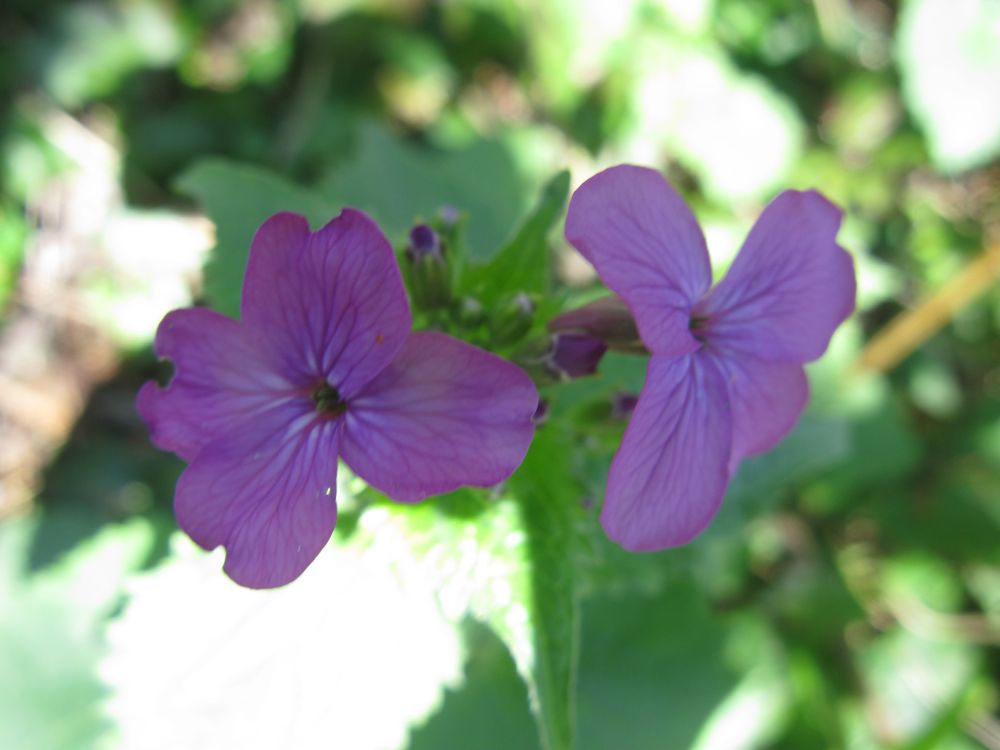
And so does Honesty which grows in the woodland area of the garden. Last year, when I picked the dried seedheads, I deliberately scattered the seeds hither and yon.
  

Laos: Night falls on the Mekong...


    In the couple of weeks we were in Luang Prabang, I'd say we spent at least five evenings sipping beer as we watched the sun set over the Mekong river and the longboats cross back and forth.
    And soon after that, it was time to go home to France.

Laos: Luang Prabang: How to Dry Food.


In this hot climate, drying is a common way of preserving food. We came upon these ladies making small tortilla-like cakes. First they made a firm dough, then broke pieces off and roll them between their hands into small balls. These were flattened, and sandwiched between sheets of plastic wrap. Finally, they were set out on bamboo racks to dry by the roadside. They look like speckled popadoms and I think they are made with some kind of yam.


River weed is another local specialty. You can buy it at the market in thin dark green sheets speckled with sesame seeds. It's served deep-fried, and often smeared with chili paste. One afternoon, I was exploring the banks of the Mekong and found this lady using a plastic bag to harvest weed from the river.


Elsewhere it was drying on a roof.


Here it is (top right) as part of a platter along with Luang Prabang sausage, dried pork with sesame, eggplant dip with a pleasant, slightly charred, flavour, lip-burning chili sauce with bits of water buffalo skin in it and, in that bamboo container, sticky rice.


Finally, rice cakes drying in the sun. I'm guessing they're eaten as snacks.

Laos: Learning to cook Laotian dishes.

    It's like anywhere in the world: a border crossing between two countries doesn't mean a complete change in what people eat. For instance, the cuisine in the French city of Nice and the Italian town of Ventimiglia just along the coast have more in common than say Nice and anywhere in Normandy.
    Northern Thailand and Laos are no exception.
    I'd done a couple of one-day courses in Thai cuisine but knew very little about cooking in Laos. So, early on in our first week in Luang Prabang, I signed up for a half-day cooking course at the Villa Santi, a boutique hotel in one of the town's old colonial buildings. The course was held at its sister property, the Santi Resort and Spa, about 5 km out in the country.
    A little bus took me there. For the first half hour I was left to my own resources so I wandered around the grounds. It was the most beautiful day with just a faint haze over the mountains.

The resort has planted a small rice paddy in its grounds.

     The best thing was...I was the only student. Just me and a young chef who didn't speak a word of English and a young hotel employee so incredibly savvy that you could almost guarantee she's going to end up running some splendiferous four-star hotel. The point was, she spoke perfect English. Not that you need language skills when you're learning to cook. Watching, tasting, that's usually enough, but it is handy to know the name of a specific ingredient if it translates into English.
 
Kaeng pak nam is watercress soup with minced pork. Light and tasty, it only took minutes to make.

Sticky rice with mango or sangaka mamueng as it's called locally. 

Once I'd finished cooking, hotel staff set up my lunch table on the terrace with its view over the rice paddy. Fresh spring rolls, a green papaya salad, the soup, sweet and sour fish. chicken curry and the sticky rice with mango. 
     This half-day made me greedy for more. I'd noticed a few posters tacked up on lamp posts advertising the Tamnak Lao cooking school, an adjunct to the restaurant of the same name. I signed up, showed up and got stuck in.
   We began with a walk around the Phousi Market (see earlier post)) then took a tuktuk back to the kitchen. Four students, two instructors. This time, they demonstrated the dish, then left us to make it ourselves from prepped ingredients using the recipe provided.

Ingredients at the ready...cooking is so much easier when someone else does all the chopping and measuring.

On your left, a Luang Prabang salad. I found the mayonnaise-type dressing too rich (it was made with hard-boiled egg yolks), and I'd probably leave out the optional minced pork. Otherwise, a keeper. 

Finished dishes. Simple garnishes of lettuce leaves, tomato and cucumber...

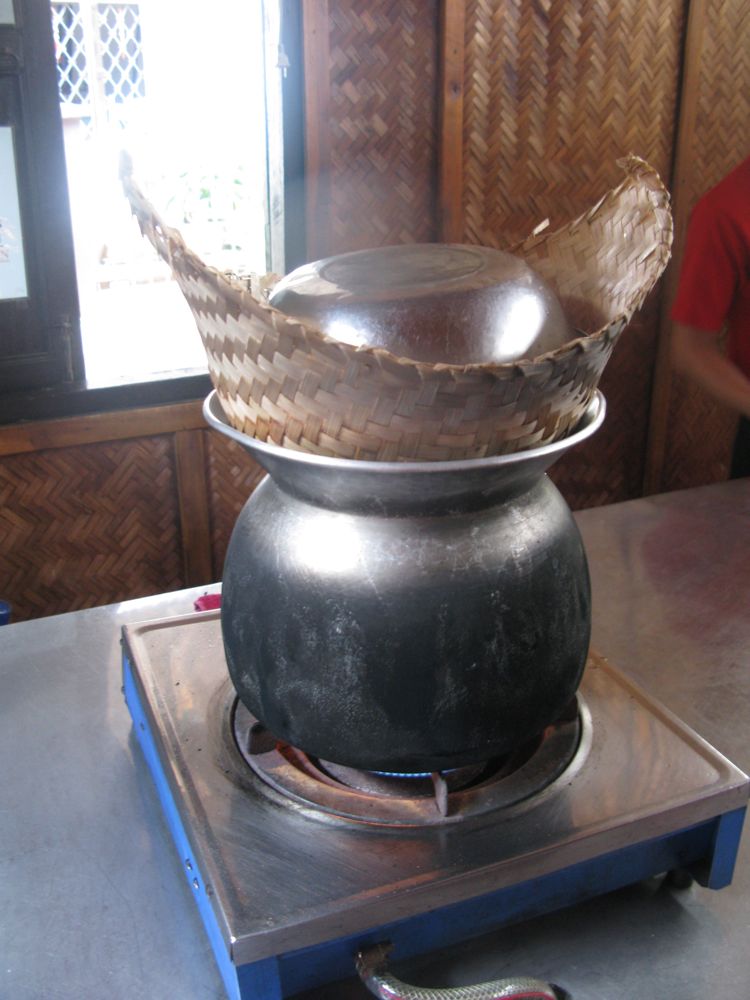
How to make sticky rice...

     Going through the recipe book I brought back, my notes on the sauce-stained pages show the dishes I'm likely to make back home in France.
   "Excellent" is how I've described feu khua: fried sticky rice noodles with chicken and vegetables. (What I really like about these recipes is that the author included lots of suggested substitutes if you can't get your hands on the exact ingredients). 
     Hmm, another "excellent"--this time for chicken larp, a spicy cold salad made with chopped chicken. By the way, this wasn't pre-chopped. Instead, each of us was given some raw chicken breast, a chopping board and a cleaver. 
     "Very good. Needs mushrooms for texture," is what I wrote about kheua sen lon--noodles with pork, vegetables and woodear fungus. The sensible substitute suggested  for the fungus is green beans--far easier to get my hands on those at the local market until I make a trip to the Asian supermarket in Toulouse. 
      "OK but not my favourite" was a pork casserole. Let's move on...
      That's more like it. "Excellent and easy" applies to khua maak kheua gap moo or fried eggplant with pork but geng phet (chilli casserole) only scored a "very good." 
      One of the cornerstones of Lao cooking is jeowbong, a thick chili paste. Making that and sticky rice wound up an intensive day.